How AIIM works
AIIM asks a large language model to evaluate documented public research and software contributions. Its heuristic score is framed as a share of world GDP, but is not a validated measurement of causal economic or scientific impact. The software uses these estimates in proportional funding calculations. Payments depend on available donated funds and eligibility requirements. Read about the experimental approach and its limitations.
The app beta (see also the source) has been released. We need money to make it useful. See also the project status and the paper.
Deep dive: implementation and participation
The sections below provide operational detail for researchers, developers, reviewers, and donors who want to assess AIIM beyond the landing-page summary.
Getting started
Connect your public contribution records to begin. AIIM does not require a science degree or a traditional grant proposal. Connecting an account does not guarantee eligibility or payment.AIIM does not require grant writing, which can reduce the application work compared with traditional grant proposals; actual setup time varies. Users may still need to:
- curate ORCID or GitHub records;
- establish authorship;
- respond to disputes;
- document work missing from supported sources;
- satisfy identity requirements.
Why this project matters
Unpublished research and unused resources can limit the value society obtains from science. Bowers et al. (2023), using a survey of 301 researchers, estimated approximately $6.2 billion in cumulative unused research resources at US universities. This is not an estimate of annual global losses or foregone innovation. The wider opportunity costs are difficult to quantify.
AIIM aims to support useful research and open-source software by evaluating documented contributions without making degrees or institutional affiliation mandatory. Whether this approach improves funding efficiency and fairness remains a question for testing. See the economic evidence and project goals.
- Which Services Science DAO Provides for Researchers and Free Software Developers
- Why blockchain improves research funding
- Science DAO vs Traditional Funding
- How Science DAO funds research on-chain
- AIIM’s proposed approach to AGI safety
AIIM also proposes rewards for science marketers and reviewers who help useful work reach relevant audiences. This is an intended role in the funding model; its effectiveness remains to be tested.
How the science gets stuck
“This illustrates a dependency problem that can occur in both science and software: (image from https://xkcd.com/2347/):
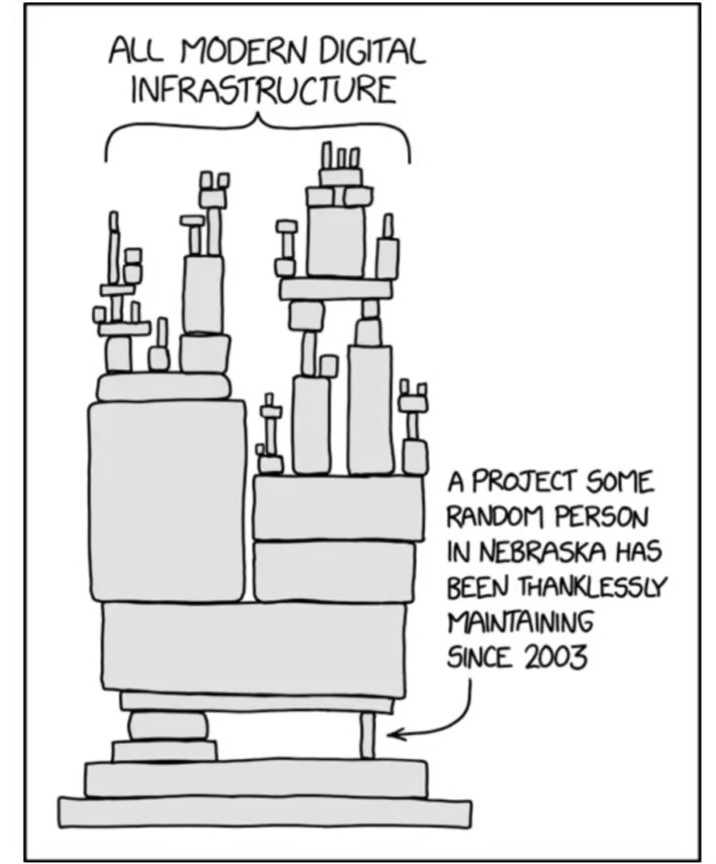
The idea behind the picture is: A small but essential component can become a major bottleneck. If that component is missing—because it has not yet been discovered, published, maintained, or made accessible—the value of a much larger scientific or software system may be substantially reduced.
Predatory and deceptive publishing practices can weaken quality control and mislead researchers.
Useful work can also receive too little attention. Poor discoverability may delay recognition and downstream use.
Victor Porton describes difficulties publishing and promoting his research in his personal story. His assessment of its broader importance is a motivation for this project, not independent evidence of a measured delay to global science. Support development and testing of AIIM.
Help Turn AIIM’s Beta into Evidence
AIIM remains experimental. The next proposed milestone is a five-month public adversarial test, with $1,000 planned for distribution to eligible funding recipients. Donations support the work required to run and evaluate that test.
Fund the public test → Test proposal → Independent review →
AI-generated evaluations can contain factual errors or biases; decentralized governance and non-custodial components remain under development. Public testing, auditability, and external criticism remain part of the project.