
Press & media kit · Updated 29 September 2026
This page is a compact source for journalists, editors, podcasters, researchers, conference organizers, and other media professionals covering the science-funding initiative, SciWard, or related projects. For claims that may change over time, follow the linked source pages rather than treating this press kit as the final record.
30-word description
the science-funding initiative develops experimental infrastructure for funding science and open-source software. Its flagship project, SciWard, uses AI-assisted evaluation of documented contributions to help allocate available donated funds.
100-word description
the science-funding initiative is an online project developing experimental tools for transparent funding and coordination in science and open-source software. Its flagship project, SciWard, is an operational beta that uses AI-assisted assessments of documented research and software contributions as inputs to funding allocation. The current beta still uses custodial and administrative components; the current system retains administrative oversight. Payment transactions are recorded on-chain, while current payment initiation remains off-chain. the science-funding initiative is preparing public testing and explicitly invites independent external criticism. SciWard is experimental and has not yet been independently validated as an effective or fair funding system.
Current status
As of 29 September 2026:
- SciWard: operational beta. Current product status →
- Validation: independent validation is still pending. Testing & Evidence →
- Governance: quorum-based voting is implemented; an administrator may intervene only as an extraordinary fallback. Details →
- Payments: payment transactions are recorded on-chain; current payment initiation is still off-chain through a custodial Node.js workflow. Transparency →
- Decentralization: SciWard uses centralized administrative control. The former DAO arrangement is no longer operating, and the planned ICP migration was discontinued. Current governance disclosure →
- Next proposed evidence milestone: a five-month public adversarial test. The published plan describes a $1,300 funding target: $1,000 for recipient payments and $300 for AI, hosting, and related operating costs. Adversarial testing plan →
What is established — and what is not
Established/documented: the beta application exists; source code is publicly inspectable; payment records are recorded on-chain; the project documents current custodial and administrative limitations; the testing plan and independent-review policy are public.
Not established: SciWard has not been independently validated as an accurate measure of scientific or economic impact, as a fair allocation system, as resistant to strategic manipulation, or as superior to traditional funding mechanisms. AI-generated scores are heuristic estimates and can be wrong or biased.
For a claim-by-claim view, use SciWard in 10 Citable Claims and the SciWard Claim–Evidence Graph.
About the science-funding initiative
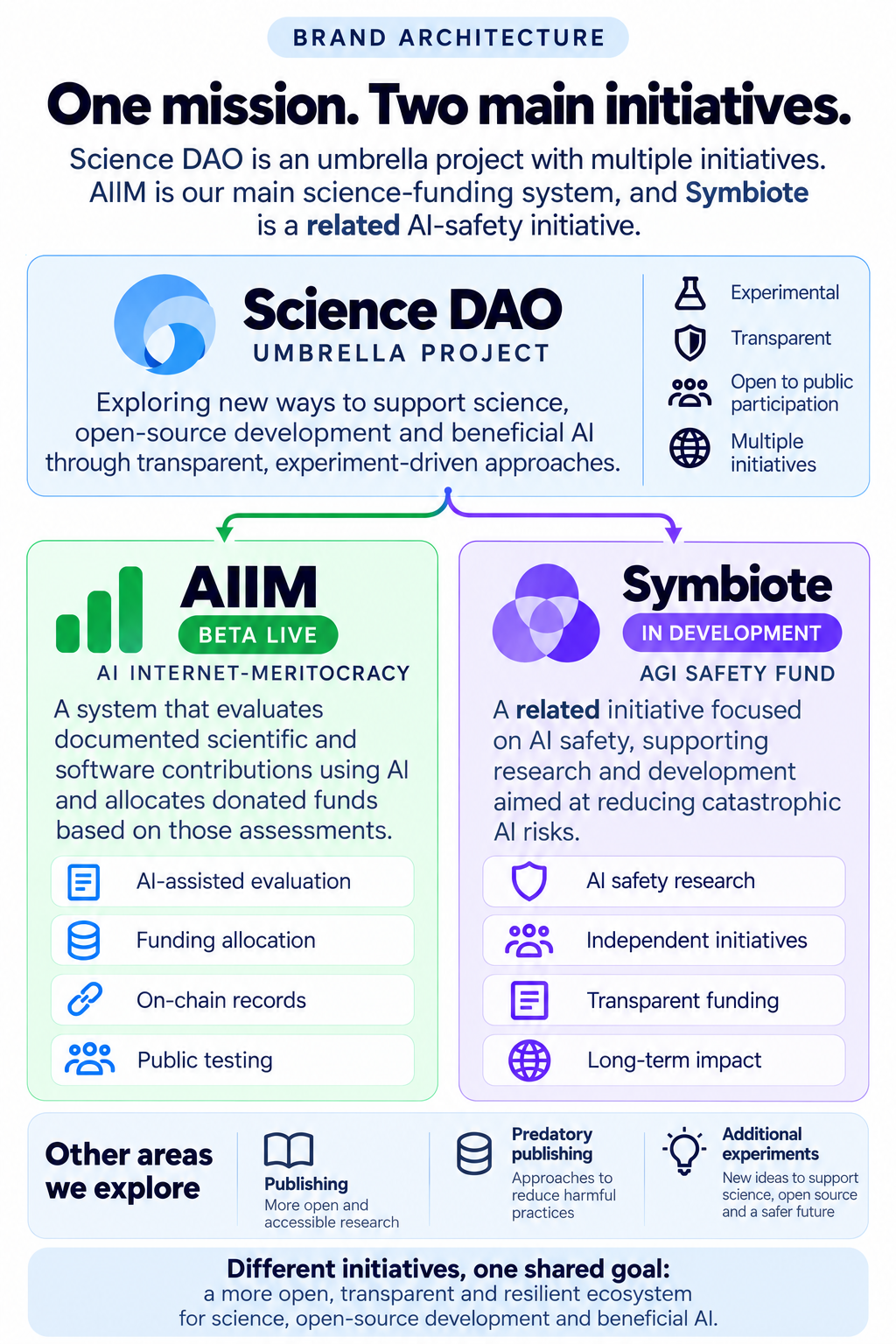
the science-funding initiative is the umbrella project. Its work includes SciWard, science-funding experiments, open-source infrastructure, and related projects. SciWard is a project rather than a separately incorporated charity; governance remains centralized. Donations for the project are legally received and controlled by Victor Porton’s Foundation. For governance, legal, financial, and conflict-of-interest disclosures, see Transparency and About Us.
Founder / principal contributor
Victor Porton is CEO of the science-funding initiative, a mathematician and software developer, and the primary developer behind SciWard. Public verification links, research profiles, publications, software repositories, and source documents are collected on the Key Contributors page.
Short bio for media use: Victor Porton is a mathematician and software developer building the science-funding initiative and SciWard, an experimental AI-assisted funding system for science and open-source software. His public work includes mathematics research, software development, and open-source projects.
Key project links
- SciWard overview — what the system is and how it is intended to work.
- SciWard beta app — public application.
- Source code — public GitHub repository.
- Product Status — current implementation and limitations.
- Testing & Evidence — evidence hub and validation priorities.
- Adversarial Testing — proposed public red-team test.
- Independent Review — reviewer packet and policy.
- Transparency — governance, finances, technical limitations, and conflicts of interest.
- 10 Citable Claims — stable, source-linked statements.
- Claim–Evidence Graph — claims connected to supporting evidence, limitations, and next tests.
Media assets
The following existing site assets can help reporters understand the project. For reuse permissions, attribution requirements, or high-resolution originals, please contact us.
- Victor Porton photo
- SciWard product-status screenshot
- Informal SciWard workflow diagram
- the science-funding initiative ecosystem image
Frequently asked questions for journalists
Is the science-funding initiative currently a organization?
No. The former DAO-based arrangement is discontinued, and SciWard operates with centralized administrative control. The ICP migration is no longer planned. See Transparency.
Is SciWard already proven to work?
No. SciWard is an operational beta, but independent validation remains pending. The project is explicitly treating adversarial testing, reproducibility, stability, and external review as open evidence questions.
Does SciWard measure the true impact of scientific work?
No validated causal-impact measurement has been established. SciWard’s AI-generated scores are heuristic estimates used in its experimental allocation logic. See SciWard-C3.
Is SciWard fully on-chain or non-custodial?
No. Payment transactions are recorded on-chain, but current payment initiation and wallet management still use off-chain custodial components. the current system retains administrative oversight.
Does a researcher need a PhD?
A science degree is not a general prerequisite for consideration. Other requirements can still apply, including documentation, authorship, identity, supported sources, eligibility rules, and available funds.
Does the science-funding initiative invite critical coverage?
Yes. The project explicitly invites independent analysis, including critical, mixed, or negative conclusions. See the Independent Review page.
Media contact
For interviews, factual checks before publication, requests for source documents, asset permissions, or other media inquiries, use the the science-funding initiative Contact page →.
When possible, please identify the publication, topic, deadline, and which the science-funding initiative or SciWard claim you are checking. Questions that challenge the project’s claims are welcome.
Editorial note
This press kit is maintained by the project itself and should be treated as a primary source about how the science-funding initiative describes its own work, not as independent validation. Journalists and researchers are encouraged to consult the linked source code, records, external sources, and independent reviews.
Help Turn SciWard’s Beta into Evidence
SciWard remains experimental. The next proposed milestone is a five-month public adversarial test, with $1,000 planned for distribution to eligible funding recipients. Donations support the work required to run and evaluate that test.
Fund the public test → Test proposal → Independent review →
AI-generated evaluations can contain factual errors or biases;. Public testing, auditability, and external criticism remain part of the project.