Support Science and Free Software Development with Cryptocurrency Donations

Fundraising experience for your donors

Grants Science (save science by cryptocurrency)

Historical notice: Grants Science describes an earlier Science DAO model. It is no longer the project’s primary approach; the current flagship is AI Internet-Meritocracy (AIIM).

This is the page of Grants team in the historical DAO implementation.

Please, support us. (“Think big, start small” – even a little donation on this beginning stage of the project will have a great effect.) Also, please link to this site, to increase its rating on Google. Also we welcome volunteer software developers to join.

This project is about gathering and spreading scientific funds more effectively than in traditional scientific grants, with emphasis on fundamental science, by leveraging cutting edge blockchain/cryptocurrency technologies. Currently scientific publishing is in a miserable state: some projects receive funding and exposure and some don’t. If a very important project receives no exposure, the science get stuck. We are to make scientific financing fair, to unstuck science.

How the science gets stuck

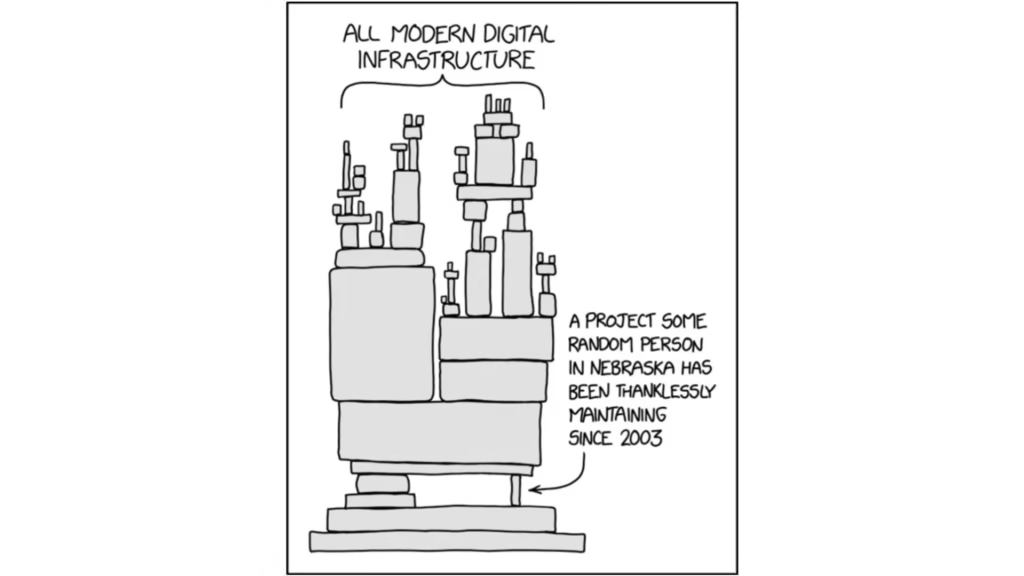
This is how science works in modern world (image credited from Permanent link to this comic: https://xkcd.com/2347/):

all world infrastructure on a shaky foundation

Some researchers may receive little visibility because their work is difficult to discover through ordinary search and academic networks. Poor discoverability can delay recognition and make follow-up work less likely, but it does not make an entire topic scientifically unpublishable.

Victor Porton has cited his own experience with funcoids, ordered semigroup actions, and discontinuous analysis as motivation for this project. Those experiences are relevant as personal project history, but they do not by themselves establish that lack of marketing blocked the development of those fields.

Historical strategy to improve discoverability and funding

The earlier Grants Science proposal aimed to improve financing of fundamental science and free software, especially underfunded dependencies and basic research, using cryptocurrency and dependency-aware funding.

The items below describe that earlier proposal; they are not the current AIIM architecture.

  • The proposal would allow donors to direct part of a donation to cited works and software dependencies.
  • It also proposed affiliate-style incentives to improve discoverability of under-promoted research. Poor promotion may reduce visibility and slow follow-up work; it does not make a scientific topic categorically non-publishable.
  • Early promoters of a basic-science project or software library could receive a share of later funds as a historical incentive mechanism.
  • The system was intended to use public APIs such as software registries and scholarly databases to identify dependencies.
  • Users could publish cryptocurrency addresses through public developer or research profiles.

Historical peer-review proposal

The original Grants Science concept proposed an experimental model called “peer review by donations.” Science DAO no longer treats a donation threshold as equivalent to scientific peer review. Current review work is expected to involve substantive technical evaluation rather than a donor-payment threshold.

Historical implementation plan

The earlier proposal considered implementation using DFINITY Internet Computer technology and dependency-aware cryptocurrency funding.

See this historical planning discussion for additional context. At that time, Science DAO operated with a DAO-oriented model; the current project is not yet a fully decentralized DAO.

The proposal also explored SEO and outreach as ways to improve research discoverability. Such measures may improve visibility, but they do not guarantee that important research will rank highly or receive recognition.

A related draft article, “The High-Level Algorithm of Financing Fundamental Science and Software, for Blockchain Implementation: Why This Way and Peculiarities of Information Exchange and Payments,” remains part of the historical project record.

View the historical article draft.

Historical planned use of funds

  • programmer compensation
  • web infrastructure
  • project outreach and advertising
  • excess funds directed to science and free-software funding

👉 Donate for science.

Support Independent Science

Our flagship product, AI Internet-Meritocracy, is an app (in the stage of open beta-testing) designed to allocate donated funds to researchers and open-source developers using AI-assisted evaluation of documented contributions. Payments depend on available funds and eligibility requirements.

Help fund the proposed five-month public test of AIIM’s allocation model with distribution of $1000 to eligible funding recipients. Support the next testing milestone.

Supporting independent science is not only a matter of fairness to researchers whose expertise and work are often underfunded. It is also essential for addressing systemic failures in scientific publishing that delay discoveries and leave important results unnoticed. In science and software, even one missing component can prevent an entire system from working.

Help valuable research and open-source infrastructure move forward. Please make a donation to support independent scientists and free software developers.

Independent review

Researchers and AI-safety reviewers: We invite independent technical criticism of Science DAO, AIIM, and related AI-safety work, including critical conclusions. Please examine assumptions, human-in-the-loop mechanisms, prompt-injection risks, governance, and failure modes. Use the independent-review packet →

Disclaimer

Experimental-system notice: AI Internet-Meritocracy is an experimental funding system. Its AI-generated evaluations are heuristic judgments based on available public or connected-account evidence; they are not validated measurements of a person’s causal economic or scientific impact. Payment transactions are already recorded on-chain and can be verified on the blockchain. The current beta initiates payments off-chain through Node.js and uses custodial and administrative components. Decentralized governance and non-custodial wallets remain under development; on-chain payment records are already available. Evaluations may contain factual errors or biases and should be interpreted together with audit logs, appeals, human oversight, and published test results.